
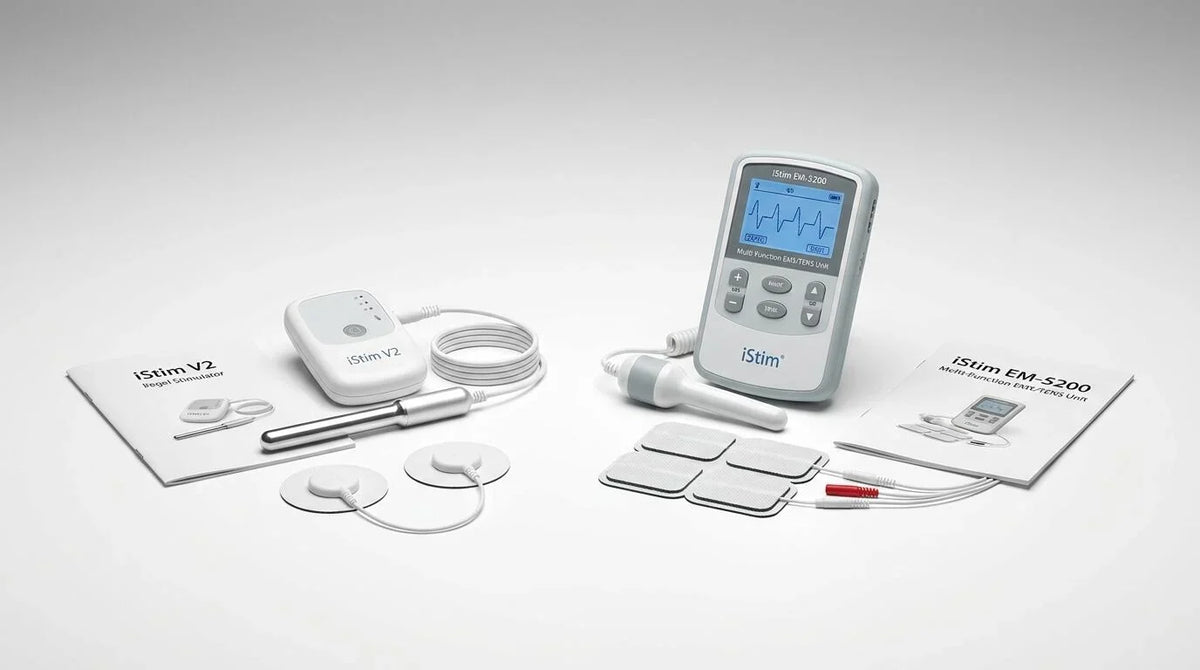
ALT: iStim V2 vs EM-5200 pelvic floor stimulator devices side by side comparison for women's health
iStim V2 vs EM-5200: Finding the Right Pelvic Floor Device for Your Body
Key Conclusion: When comparing the iStim V2 vs EM-5200, both devices offer clinically inspired electrical muscle stimulation for pelvic floor rehabilitation — but they serve distinct user profiles. The V2 is purpose-built for targeted pelvic floor therapy with a streamlined design, while the EM-5200 functions as a broader electrotherapy unit capable of addressing pelvic floor concerns alongside general muscle rehabilitation. Choosing between them depends on your specific goals, experience level, and lifestyle needs.
If you've been researching pelvic floor devices, you've likely encountered both the iStim V2 and the iStim EM-5200 — and found yourself wondering which one is truly the better fit. That's a completely fair question. Both come from iStim's trusted lineup of professional-grade electrotherapy products, both are backed by ISO-certified manufacturing standards, and both have earned loyalty from thousands of home users. But they are meaningfully different tools designed with different use cases in mind.
This article walks you through an honest, side-by-side analysis so you can make a confident, informed decision — without needing a clinic visit or a physical therapy consultation just to understand your options.
Who Should Read This Pelvic Floor Device Comparison
✅ Applicable Scenarios:
- Women recovering from childbirth who want to rebuild pelvic floor strength through at-home EMS therapy
- Adults experiencing urinary incontinence, pelvic organ prolapse symptoms, or general pelvic weakness who are exploring non-pharmaceutical treatment options
- Individuals who have already begun manual Kegel exercises and want to upgrade to an electronic stimulation device for faster, more consistent results
- Fitness-oriented users who want a device that doubles as a pelvic floor trainer and a broader muscle recovery or TENS pain relief tool
- Research-driven shoppers aged 30–65 who prefer understanding clinical context before purchasing a wellness device
❌ Not Applicable/Cautions:
- Individuals who are pregnant should not use internal pelvic floor stimulation devices without direct medical approval
- People with implanted electronic devices such as pacemakers or defibrillators should avoid electrical stimulation therapy entirely unless cleared by a physician
- Anyone with active pelvic infection, open wounds in the treatment area, or certain neurological conditions should consult a healthcare provider before use
Why Pelvic Floor Health Is Now a Home Wellness Priority
Pelvic floor dysfunction is far more common than most people realize — and far more treatable than many assume. Research consistently shows that conditions like stress urinary incontinence, overactive bladder, and pelvic organ prolapse affect a significant proportion of women, particularly after childbirth or during menopause. Yet for decades, treatment required repeated visits to specialized physical therapists or urogynecologists.
That landscape is shifting. The rise of consumer-grade electrotherapy devices — grounded in the same clinical science used in hospital-based pelvic rehabilitation programs — has made it possible for individuals to take meaningful, evidence-backed steps toward pelvic health from their own homes. Electrical muscle stimulation (EMS) works by delivering low-level electrical impulses through a probe or electrode pad, triggering involuntary pelvic floor muscle contractions. Over time, these contractions strengthen the muscle group in a way that mirrors the therapeutic benefit of guided Kegel exercises, but with greater consistency and less reliance on proper voluntary technique.
If you're new to this space, it's worth reading our in-depth guide on Best Kegel Trainer for Women: EMS vs Manual Kegels to understand how electronic stimulation compares to traditional manual Kegel practice — and why many pelvic health specialists now recommend combining both approaches.
iStim has emerged as one of the most trusted names in this growing category, offering devices that translate clinical-grade EMS and TENS technology into accessible, home-friendly formats. Among their most discussed products are the V2 Kegel exerciser and the EM-5200 electrotherapy unit — each popular for good reason, but each suited to a somewhat different user.
Deep Dive: iStim V2 vs EM-5200 — Head-to-Head Analysis
Three Steps to Choosing the Right Device for You
Step 1: Define Your Primary Goal
Before comparing any two devices, start by getting clear on what you actually need. Are you primarily focused on pelvic floor rehabilitation — strengthening muscles after childbirth, reducing urinary leakage, or improving pelvic tone? Or do you want a multi-functional electrotherapy unit that handles pelvic floor stimulation alongside other applications like lower back pain relief or leg muscle recovery? This single question will do more to guide your decision than any feature list.
Step 2: Assess Your Comfort Level with Electrotherapy
Your experience level matters. If you're brand new to electrical stimulation devices, a dedicated Kegel stimulator with a focused, user-friendly interface tends to feel less overwhelming. If you've used a TENS or EMS device before and are comfortable navigating intensity levels and mode settings, a more feature-rich unit may offer greater long-term value without the learning curve becoming a barrier.
Step 3: Consider Your Lifestyle and Usage Habits
Think practically: How often will you realistically use the device? Do you prefer a simple "set and go" routine, or do you enjoy customizing your sessions? Will you use it exclusively for pelvic health, or do you want to share it with a partner for other electrotherapy needs? Matching the device's design philosophy to your actual lifestyle is the difference between a product that gathers dust and one that becomes a genuine part of your wellness routine.
Comparing the iStim V2 and EM-5200: Key Dimensions
Both devices carry iStim's professional pedigree, but they serve users differently across several important dimensions. The table below draws on available product information to help you visualize the contrast:
| Comparison Dimension | iStim V2 | iStim EM-5200 |
|---|---|---|
| Primary Function | Dedicated Kegel / pelvic floor EMS stimulator | Dual-purpose EMS and TENS electrotherapy unit |
| Pelvic Floor Use | Yes — purpose-designed for pelvic rehabilitation | Yes — supports pelvic floor stimulation as one of multiple applications |
| Additional Therapy Modes | Focused on pelvic health programs | Includes modes for broader muscle stimulation and pain relief |
| Probe Compatibility | Designed for use with vaginal stimulation probe | Compatible with electrode pads and pelvic floor probe accessories |
| Target User | Women focused on pelvic rehabilitation | Users seeking versatile, multi-region electrotherapy |
| Interface Complexity | Streamlined and straightforward | Feature-rich with multiple adjustable parameters |
| Portability | Compact and dedicated | Portable but slightly more equipment to manage |
| Manufacturing Standard | ISO-certified Taiwanese manufacturing | ISO-certified Taiwanese manufacturing |
| Amazon Customer Base | Part of iStim's 20,000+ customer community | Part of iStim's 20,000+ customer community |
Understanding the iStim V2: A Purpose-Built Pelvic Floor Companion
The iStim V2 was designed with one central goal in mind: making pelvic floor rehabilitation accessible, effective, and straightforward for everyday users. It is a dedicated Kegel electronic stimulator — meaning every aspect of its design, from its pre-set therapy programs to its probe compatibility, has been optimized specifically for pelvic floor strengthening.
Who Benefits Most from the iStim V2?
The V2 is particularly well-suited for women who are new to electrical pelvic floor stimulation and want a device that removes complexity from the equation. Its focused design means you don't need to navigate through general TENS settings or muscle groups unrelated to your goal — you simply set your intensity, follow the program, and let the device do the work.
Postpartum women, in particular, find the V2 to be an excellent entry point into structured pelvic rehabilitation. After childbirth, the pelvic floor often experiences a combination of overstretching, nerve disruption, and muscle weakening that can persist for months or years without targeted intervention. The V2's EMS-based approach helps stimulate those muscle fibers directly — a meaningful advantage when voluntary muscle control is still being restored. For those specifically looking at postpartum recovery routines, this guide on the best pelvic floor device for postpartum routines offers additional context on what to look for.
The V2 is also a strong fit for women dealing with mild to moderate stress urinary incontinence — the type of leakage that occurs during coughing, sneezing, or exercise. Clinical research consistently supports EMS-based pelvic floor therapy as a first-line, non-surgical intervention for this condition, and the V2's targeted design makes consistent therapeutic use easy to maintain at home.
Key Strengths of the V2
- Dedicated pelvic floor focus with no extraneous features to confuse first-time users
- Designed for use with an internal vaginal probe, enabling direct muscle engagement that surface-level approaches cannot replicate
- Compact and discreet — easy to use privately and store conveniently
- Built on iStim's trusted manufacturing platform with ISO-certified quality control
Where the V2 Has Limitations
If your needs extend beyond pelvic floor rehabilitation — for example, if you also experience chronic lower back pain, need leg muscle recovery support, or want to share the device for general TENS therapy — the V2 was not designed for those applications. Its strength is also its constraint: specialization.
Understanding the iStim EM-5200: Versatility Meets Pelvic Health
The iStim EM-5200 takes a different approach. It is a multi-functional electrotherapy device that combines EMS and TENS capabilities, supporting pelvic floor stimulation as one of several therapeutic applications. Where the V2 is a specialist, the EM-5200 is a generalist with meaningful pelvic floor capability.
Who Benefits Most from the EM-5200?
The EM-5200 is an excellent choice for users who want a single device to address multiple wellness needs. If you're managing pelvic floor weakness alongside other concerns — chronic back tension, sports recovery, or general muscle conditioning — this unit allows you to consolidate your electrotherapy toolkit without purchasing separate devices.
It also appeals to users who appreciate having control over their therapy parameters. The EM-5200 offers adjustable intensity levels and multiple operational modes, which experienced electrotherapy users often find valuable for tailoring sessions to their current condition and progression goals. If you're someone who enjoys dialing in your recovery routines with precision, the EM-5200 rewards that engagement. For an overview of what adjustable intensity means in practice for pelvic health specifically, see our resource on the best pelvic floor trainer with adjustable intensity.
The EM-5200 is also a practical choice for households where multiple family members might benefit from electrotherapy — since it's not limited to pelvic floor use, its utility extends across users and needs.
Key Strengths of the EM-5200
- Dual EMS and TENS functionality for comprehensive electrotherapy at home
- Supports pelvic floor rehabilitation with appropriate probe accessories alongside surface electrode pad use
- Multiple adjustable modes for experienced users who want customization
- Versatile enough to address muscle recovery, pain relief, and pelvic health under one device
- Backed by the same ISO-certified manufacturing standards that underpin all iStim products
Where the EM-5200 Has Limitations
The EM-5200's versatility introduces a slightly steeper learning curve. New users unfamiliar with electrotherapy may initially find the range of settings more complex to navigate than the focused simplicity of the V2. If your sole focus is pelvic floor rehabilitation and you have no interest in additional electrotherapy applications, the EM-5200's broader feature set may feel like more than you need.

ALT: iStim V2 and EM-5200 pelvic floor EMS devices compared for home-based pelvic floor rehabilitation
Advanced Considerations: Making the Most of Either Device
Combining Electrical Stimulation with Manual Kegel Practice
A common misconception is that once you start using an EMS-based pelvic floor device, manual Kegel exercises become unnecessary. In reality, the most effective pelvic rehabilitation programs typically combine both. Electrical stimulation helps activate and condition muscle fibers — particularly helpful when voluntary control is limited — while conscious Kegel exercises build the neural-muscle connection needed for real-world function. Think of the device as a trainer that teaches your muscles the right movement pattern, and manual practice as the homework that reinforces it.
Intensity Progression: Don't Rush the Process
Whether you choose the V2 or the EM-5200, the principle of gradual intensity progression applies to both. Starting at the lowest comfortable stimulation level and incrementally increasing over multiple sessions is not just a comfort strategy — it reflects how neuromuscular adaptation actually works. Pelvic floor muscles, like any muscle group, need time to build strength and endurance. Users who try to accelerate by starting at high intensity often experience discomfort without proportionally better results.
Probe Hygiene and Device Longevity
For any device used with an internal probe, hygiene protocols are non-negotiable. Always clean the probe with appropriate disinfectant before and after each use, follow the manufacturer's guidelines for probe care, and replace probes according to the recommended schedule. Proper maintenance not only protects your health but extends the useful life of the device itself — a practical consideration for anyone making a long-term investment in their pelvic wellness.
Clarifying a Common Misconception: "More Settings = Better Results"
The EM-5200's broader mode selection does not automatically make it more effective for pelvic floor rehabilitation than the V2. Therapeutic outcomes depend on consistent use, appropriate intensity, and correct technique — not on the number of available settings. For users whose only goal is pelvic health, the V2's focused simplicity often supports better adherence because there are fewer decisions to make each session.
Frequently Asked Questions FAQ
Q1: How do I know if the iStim V2 or EM-5200 is right for my specific pelvic floor condition?
The most reliable starting point is identifying whether your needs are pelvic-specific or broader. If you're focused exclusively on pelvic floor rehabilitation — addressing postpartum recovery, urinary incontinence, or general pelvic weakness — the iStim V2's dedicated design offers a focused, accessible path forward. If you also want to address muscle pain, back tension, or recovery in other body regions, the EM-5200's dual EMS/TENS capability gives you significantly more therapeutic range. When in doubt, consulting a pelvic floor physical therapist can help clarify which approach aligns with your clinical picture.
Q2: Is it safe to use an electronic pelvic floor stimulator at home without professional supervision?
For most healthy adults without contraindications, iStim's pelvic floor devices are designed for safe independent home use. Both the V2 and EM-5200 are built to professional-grade standards with ISO-certified manufacturing, offering the same technology foundation used in clinical settings. However, individuals who are pregnant, have implanted medical devices, active pelvic infections, or significant neurological conditions should always consult a healthcare provider before beginning electrical stimulation therapy. Starting at low intensity and following the included guidelines reduces risk for new users.
Q3: How long does it typically take to see results from pelvic floor electrical stimulation therapy?
Most users report noticing initial improvements — such as greater pelvic muscle awareness, reduced urinary urgency, or increased muscle tone — within several weeks of consistent use. More significant functional changes, such as measurable reduction in stress incontinence episodes, are commonly reported after six to twelve weeks of regular sessions. Results vary based on individual baseline condition, session frequency, and adherence to proper technique. Combining EMS device use with conscious Kegel practice generally accelerates progress compared to either approach used in isolation.
Summary
Choosing between the iStim V2 and the EM-5200 ultimately comes down to three core considerations:
1. Specificity of need: The V2 is the stronger choice when pelvic floor rehabilitation is your singular focus. Its dedicated design removes complexity and makes consistent use easier — a genuine advantage for first-time electrotherapy users and postpartum women rebuilding pelvic strength.
2. Versatility of application: The EM-5200 earns its value through breadth. If you want one device to handle pelvic floor therapy alongside TENS pain relief, muscle conditioning, or shared household use, the EM-5200's multi-functional platform delivers meaningfully more per dollar invested.
3. Confidence in the brand: Regardless of which model you select, both devices carry iStim's commitment to ISO-certified manufacturing, clinical-grade electrotherapy technology, and a proven track record with over 20,000 Amazon customers. You're not choosing between quality and quality — you're choosing between two well-engineered tools designed for different primary uses.
The best pelvic floor device is the one you'll actually use consistently. Let your lifestyle, your goals, and your comfort with technology guide the decision — and know that either path puts you ahead of inaction.
Ready to Find Your Perfect Match?
Ready to take control of your pelvic health from the comfort of home? Explore iStim's full lineup of professional-grade TENS, EMS, and Kegel devices at https://istim.com/ and find the right drug-free solution tailored to your needs. Trusted by over 20,000 customers and built to clinical standards, iStim is here to help you move, feel, and live better — every day.
References
- National Institute of Diabetes and Digestive and Kidney Diseases (NIDDK). "Kegel Exercises."
https://www.niddk.nih.gov/health-information/urologic-diseases/kegel-exercises - American College of Obstetricians and Gynecologists (ACOG). "Pelvic Support Problems."
https://www.acog.org/womens-health/faqs/pelvic-support-problems - National Association for Continence (NAFC). "Electrical Stimulation for Bladder Control."
https://www.nafc.org/electrical-stimulation - Mayo Clinic. "Kegel Exercises: A How-To Guide for Women."
https://www.mayoclinic.org/healthy-lifestyle/womens-health/in-depth/kegel-exercises/art-20045283 - PubMed / National Library of Medicine. "Electrical Stimulation in the Treatment of Stress Urinary Incontinence."
https://pubmed.ncbi.nlm.nih.gov/
Note: Standards and clinical guidelines may be updated over time. Please verify the latest official documents or consult a qualified healthcare professional for personalized guidance.
About iStim
iStim is a Los Angeles-based electrotherapy brand specializing in professional-grade TENS, EMS, and Kegel devices engineered for safe, effective home use — backed by ISO-certified Taiwanese manufacturing and trusted by 20,000+ Amazon customers for drug-free pain relief and muscle stimulation. Learn more at istim.com.
Disclaimer: This article is provided for informational and educational purposes only and does not constitute medical advice. The content is produced in partnership with iStim and reflects general wellness information. Always consult a qualified healthcare professional before beginning any new therapy or treatment program. iStim is not responsible for any actions taken based on the information presented in this article.