

ALT: Beginner woman using a Kegel exerciser device at home for pelvic floor strengthening and bladder control
Why Finding the Right Kegel Exerciser for Beginners Matters More Than You Think
Key Conclusion: Choosing the right Kegel exerciser for beginners is foundational to pelvic floor health success. An approachable, well-designed beginner pelvic floor trainer should offer gentle stimulation levels, intuitive controls, and guided feedback — helping newcomers build confidence and consistency without overwhelm. Starting with the right device dramatically improves long-term results for issues like bladder leakage, post-partum recovery, and core muscle weakness.
If you've recently started researching pelvic floor health, you may have quickly discovered that not all Kegel devices are created equal — especially for beginners. The market is flooded with options ranging from simple weighted balls to sophisticated electronic stimulators, and navigating these choices without clinical guidance can feel daunting.
The good news is that modern electrotherapy technology has made it genuinely possible to experience professional-grade pelvic floor rehabilitation from the comfort of your own home. Whether you're recovering post-partum, managing mild urinary incontinence, or simply wanting to strengthen your core from the inside out, a well-chosen electronic Kegel device can serve as your personal pelvic floor coach — meeting you exactly where you are.
This guide is specifically designed for those just starting their pelvic floor journey: we'll walk you through how Kegel exercisers work, what to look for as a beginner, how to get started safely, and why devices like those from iStim are consistently recommended by health-conscious consumers who want clinical quality without clinic costs.
Who Is This Guide For?
✅ Applicable Scenarios:
- Women experiencing mild to moderate stress urinary incontinence (leaking when sneezing, laughing, or exercising)
- Post-partum individuals looking to restore pelvic floor strength and muscle tone after childbirth
- Perimenopausal and menopausal women experiencing pelvic floor weakening due to hormonal changes
- Adults over 30 who want a proactive, preventive approach to pelvic floor health
- Beginners who have never used a Kegel exerciser and need guided, gentle stimulation to locate and activate the right muscles
- Fitness enthusiasts who want to complement their training with targeted pelvic floor strengthening
❌ Not Applicable/Cautions:
- Individuals with active pelvic infections, open wounds, or recent pelvic surgery (consult your physician before beginning any device-based therapy)
- People with implanted electronic devices such as pacemakers, as electrical stimulation may interfere with device function
- Those who are pregnant should consult their healthcare provider before using any form of electronic pelvic stimulation
- Anyone experiencing severe pelvic organ prolapse — professional clinical assessment should come first before home device use
Understanding the Pelvic Floor: Why Kegel Exercisers Are Having a Moment
The pelvic floor is a group of muscles, ligaments, and connective tissue that forms the base of the pelvis, supporting the bladder, bowel, and uterus. When these muscles weaken — which can happen due to pregnancy, childbirth, aging, hormonal shifts, or even prolonged sitting — the consequences range from inconvenient (mild leakage) to significantly life-affecting (chronic incontinence, reduced sexual function, pelvic pain).
Traditional Kegel exercises, first described by Dr. Arnold Kegel in 1948, involve repeatedly contracting and relaxing the pelvic floor muscles. The challenge? Many people — even those who have practiced for months — aren't activating the right muscles at all. Studies suggest that a significant portion of women performing Kegels unassisted are actually bearing down or engaging their glutes, rather than lifting and squeezing the pelvic floor. This is precisely where technology steps in.
Electronic Kegel devices, also called EMS (Electrical Muscle Stimulation) pelvic floor trainers or electronic pelvic stimulators, take the guesswork out of the equation entirely. By delivering gentle, controlled electrical pulses directly to the pelvic floor muscles, they elicit an involuntary contraction — meaning your muscles respond correctly every time, even if you've never felt them properly before. This is especially transformative for beginners who struggle with the mind-muscle connection required for effective manual Kegels.
The global pelvic floor muscle trainer market has grown substantially in recent years, driven by increased awareness of pelvic health, reduced stigma, and a broader consumer shift toward home-based healthcare devices. More women (and men) are actively seeking solutions that provide clinical-level effectiveness without requiring repeated visits to a physiotherapist or specialist — a trend that brands like iStim have been built to serve.
For a thorough comparison of the different approaches available, the guide on Best Kegel Trainer for Women: EMS vs Manual Kegels provides an excellent side-by-side breakdown of what each method offers and who benefits most from each approach.
How to Choose and Use Your First Kegel Exerciser: A Practical Roadmap
Three-Step Quick Start for Kegel Exerciser Beginners
Step 1: Identify Your Needs and Starting Point
Before selecting any device, take five to ten minutes to honestly assess where you are with pelvic floor health. Are you experiencing leakage? Post-partum muscle weakness? Or are you simply being proactive? Write down your primary goal — this will guide both device selection and your initial intensity settings. If you're unsure whether you can locate your pelvic floor muscles at all, an EMS-based Kegel exerciser is almost certainly your best starting point, as it activates the muscles on your behalf.
Step 2: Choose a Device With Beginner-Friendly Features
As a beginner, prioritize devices that offer multiple adjustable intensity levels (so you can start very gently and progress gradually), a simple and intuitive interface, and a probe or electrode design that is comfortable for first-time use. Look for devices backed by quality manufacturing standards — ISO-certified production, for instance, is a meaningful indicator of consistent quality and safety. Reading verified user reviews from people who started as beginners is also enormously helpful at this stage. The iStim V2 Review: Who Is It Best For? is a practical resource to understand how a real device performs for different user profiles.
Step 3: Build a Consistent Routine and Progress Gradually
Consistency matters far more than intensity. For beginners, starting with short sessions several times per week — rather than long, infrequent sessions — helps the pelvic floor muscles adapt without fatigue or discomfort. Use the lowest comfortable intensity level during your first few sessions, then gradually increase as your muscles respond. Most people begin to notice improvements in bladder control and muscle awareness within a few weeks of consistent use, though individual results vary.
Comparing Your Kegel Exerciser Options: What Beginners Need to Know
Not all Kegel devices are suitable for beginners. Below is a practical comparison of the main categories available on the market today, with a focus on factors that matter most when you're just starting out.
| Comparison Dimension | Manual Kegel Balls/Weights | App-Connected Biofeedback Devices | Electronic EMS Kegel Stimulators |
|---|---|---|---|
| Muscle Activation Method | Requires voluntary contraction (user-dependent) | Requires voluntary contraction with feedback | Involuntary contraction via electrical stimulation |
| Suitable for Beginners | Moderate — difficult if muscle connection is weak | Moderate — helpful but requires some existing awareness | High — works even if user can't feel pelvic floor muscles |
| Learning Curve | Higher — must identify correct muscles independently | Moderate — guided by app feedback | Lower — device does the work initially |
| Adjustability | Limited (weight-based progression) | App-guided | Multiple intensity levels, often program-based |
| Clinical-Grade Quality Available | Rarely | Sometimes | Yes — brands like iStim offer ISO-certified devices |
| At-Home Usability | High | High | High |
| Best For | Those with some existing pelvic floor awareness | Tech-savvy users wanting data | True beginners and those with weak or disconnected muscles |
For beginners especially, electronic EMS Kegel stimulators offer the most reliable path to correct muscle activation. The device removes the uncertainty entirely — you feel the contraction happening, which also teaches your brain and body what the correct engagement feels like over time.
What to Look For in a Beginner-Friendly Electronic Kegel Device
Adjustable Intensity Levels
This is non-negotiable for beginners. The pelvic floor is a sensitive area, and jumping into high stimulation levels too quickly can cause discomfort and discourage continued use. A quality beginner pelvic floor trainer will offer a wide range of intensity settings — allowing you to start at the lowest perceptible level and progress at your own pace.
The Best Pelvic Floor Trainer with Adjustable Intensity guide is worth reading if this feature is a top priority for you — it explores what adjustability really means in practice and what to look for when comparing devices.
Multiple Therapy Programs
Beginners benefit enormously from preset programs that automate the contraction-and-rest cycles recommended by pelvic floor physiotherapists. Rather than trying to time your own contractions, the device handles the protocol — alternating between active stimulation and rest in patterns designed to build strength without fatiguing the muscles prematurely.
Safe, Body-Compatible Design
Look for devices that are designed with hygiene and safety in mind. The materials used for probes or electrodes should be body-safe, easy to clean, and smooth enough for comfortable first-time insertion. Quality manufacturing standards — such as ISO certification — provide meaningful assurance that the device has been produced to consistent safety and performance benchmarks.
Simplicity Without Sacrificing Effectiveness
Beginners don't need a device with dozens of features they'll never use. But they do need one that's reliable, easy to navigate, and clearly communicates what's happening. A clean interface with straightforward controls makes it far easier to build a sustainable habit.
Trustworthy Brand Track Record
With health devices, brand reputation matters significantly. A company like iStim — backed by ISO-certified Taiwanese manufacturing and trusted by over 20,000 verified Amazon customers — provides the kind of credibility that matters when you're making a purchase decision around your health. Their devices are engineered to bring clinical-grade electrotherapy performance into home settings, which is exactly what beginners need: tools developed to professional standards, made accessible for everyday use.
If you're specifically looking at how electronic stimulation compares to more traditional approaches, the guide on Best Automatic Kegel Exercise Device for Women provides useful context on why automation is particularly valuable for those who are new to pelvic floor training.
Real-World Scenario: Starting From Zero
Consider someone like Maya, a 38-year-old mother of two who experienced post-partum urinary leakage and tried manual Kegels for six months with minimal improvement. Frustrated but not ready to accept this as "just how things are now," she researched electronic pelvic floor stimulators and chose an EMS Kegel device based on its adjustable intensity settings and beginner-friendly design.
In her first session, she used the lowest intensity setting — she felt a gentle pulse and, for the first time, was certain she was engaging the right muscles. Within three weeks of consistent use (three to four sessions per week), she noticed she was leaking less when sneezing. By month two, she described the improvement as "genuinely life-changing."
Maya's story reflects a pattern common among beginners who transition from manual Kegels to electronic stimulation: the certainty of correct muscle activation, combined with structured programs, dramatically accelerates the timeline to meaningful results.
For those specifically focused on bladder control improvements, the resource on Best Pelvic Floor Trainer for Bladder Control Routines offers targeted guidance on building a routine designed specifically around this outcome.
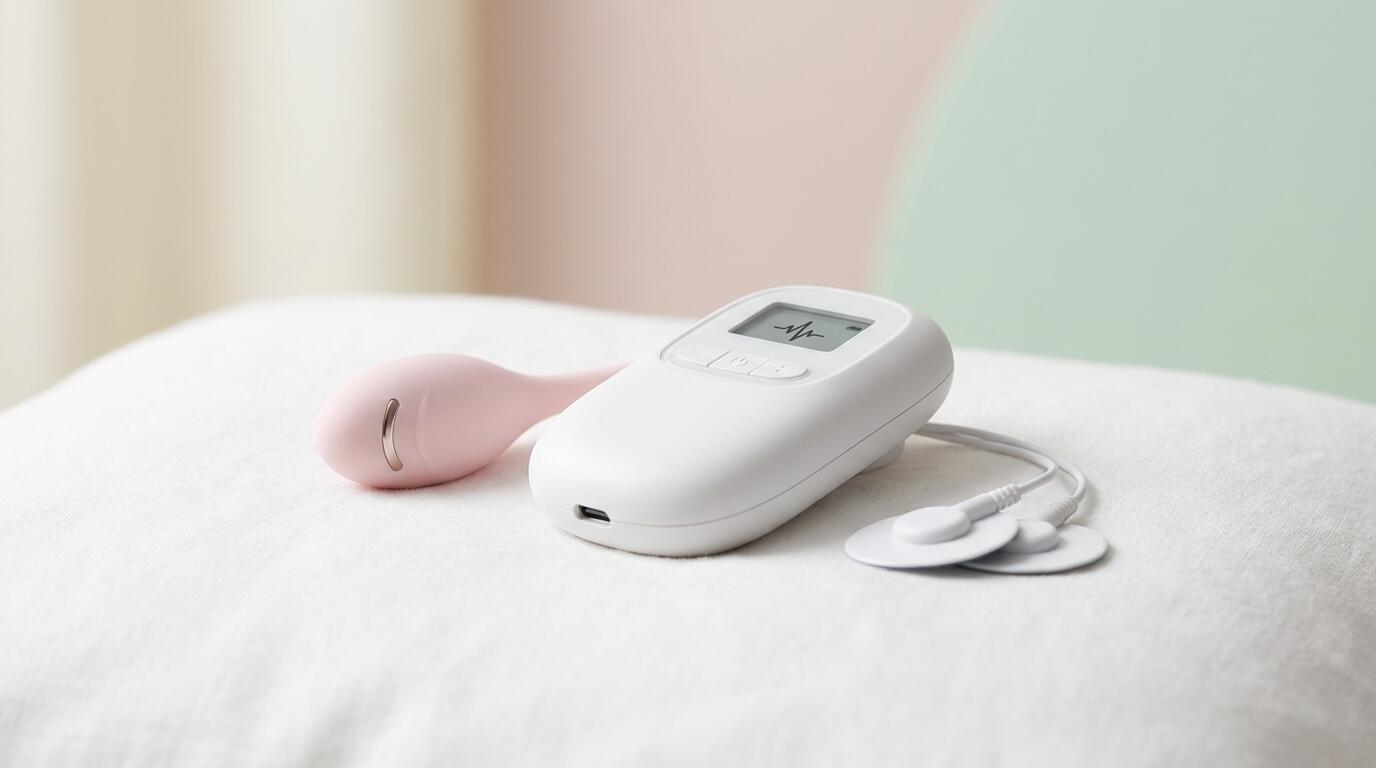
ALT: Close-up of an electronic Kegel exerciser with probe for beginner pelvic floor muscle stimulation and bladder control improvement at home
Advanced Considerations for Beginner Kegel Exerciser Users
When to Progress Beyond Beginner Settings
Many users wonder when it's appropriate to increase intensity or switch to more advanced programs. A useful rule of thumb: if you complete a full session without feeling significant muscle fatigue (a mild, pleasant tiredness in the pelvic area) and without any discomfort, you're ready to gradually increase intensity. Progression should always feel like a small step forward — not a leap.
Common Misconception: "More Intensity = Better Results"
This is one of the most prevalent mistakes among new electronic Kegel device users. Higher intensity does not automatically translate to faster or better results. The pelvic floor muscles respond best to appropriate, consistent loading — not maximal stimulation. Overworking these muscles, especially as a beginner, can cause temporary soreness or even increase symptoms like urgency. Start low, progress slowly, and trust the process.
Combining EMS Kegel Training With Manual Exercises
Electronic stimulation and manual Kegel exercises are not mutually exclusive — in fact, combining both approaches can be highly effective once you've used your device long enough to understand what correct pelvic floor activation feels like. Many pelvic floor physiotherapists recommend using the device to establish the mind-muscle connection first, then reinforcing it with manual exercises throughout the day.
ISO Certification and Why It Matters for Home Device Buyers
Not all pelvic floor devices on the market are produced to consistent safety and quality standards. ISO-certified manufacturing — like that behind iStim's devices — means the production process has been independently audited against internationally recognized benchmarks for quality management. For a health device used internally, this distinction is meaningful and worth factoring into your purchase decision.
Frequently Asked Questions
Q1: How do I know if an electronic Kegel exerciser is right for me as a beginner?
If you've tried manual Kegel exercises for several weeks without feeling confident you're activating the right muscles, or without noticing any improvement, an electronic EMS Kegel stimulator is very likely appropriate for you. These devices deliver gentle electrical pulses that cause involuntary muscle contractions, removing the guesswork from muscle location entirely. They're particularly effective for post-partum women, those with mild urinary incontinence, and anyone who has simply never felt connected to their pelvic floor muscles. Always consult your healthcare provider before starting if you have any underlying conditions.
Q2: Is it safe to use an electronic Kegel device every day as a beginner?
Starting with daily use is generally not recommended for true beginners. Like any muscle group, the pelvic floor needs recovery time between sessions, especially in the early weeks of training. Most beginner protocols suggest three to four sessions per week, allowing at least one rest day between sessions. As your muscles strengthen and adapt over several weeks, you can gradually increase frequency if desired. If you experience soreness, unusual discomfort, or a temporary increase in symptoms, reduce frequency and consult a healthcare professional.
Q3: How long does it take to see results with a beginner Kegel exerciser?
Results vary depending on individual starting point, consistency, and the specific concern being addressed. Many users report increased muscle awareness within the first two to three weeks of consistent use. Noticeable improvements in bladder control or reduced leakage are commonly reported within four to eight weeks of regular sessions. Significant, lasting pelvic floor strengthening typically develops over a three to six month period of consistent practice. The key variable is consistency — short, regular sessions outperform infrequent long ones every time.
Summary
Choosing the right Kegel exerciser for beginners comes down to three foundational principles: correct muscle activation, consistent practice, and a device built to a quality standard you can trust.
For anyone just starting their pelvic floor journey — whether post-partum, managing mild incontinence, or simply being proactive about long-term health — an electronic EMS Kegel device removes the single biggest barrier most beginners face: uncertainty about whether they're engaging the right muscles at all. With the electrical stimulation doing the initial heavy lifting, you can feel, learn, and build from a position of confidence rather than confusion.
The three key takeaways from this guide:
- Electronic stimulation outperforms manual Kegels for beginners by guaranteeing correct muscle activation from the very first session.
- Adjustable intensity, multiple programs, and quality manufacturing are the non-negotiable features to prioritize when selecting your first device.
- Consistency at appropriate intensity beats aggressive training — start gently, progress gradually, and trust the cumulative process.
Your pelvic floor health is worth investing in, and with the right tools, meaningful improvement is genuinely within reach — no clinic appointment required.
Call to Action
Ready to take the first step toward stronger pelvic floor health from the comfort of home? Explore iStim's full lineup of professional-grade TENS, EMS, and Kegel devices at https://istim.com/ and find the right drug-free solution tailored to your needs. Trusted by over 20,000 customers and built to clinical standards, iStim is here to help you move, feel, and live better — every day.
References
- National Institute of Diabetes and Digestive and Kidney Diseases (NIDDK). "Kegel Exercises".
https://www.niddk.nih.gov/health-information/urologic-diseases/kegel-exercises - American College of Obstetricians and Gynecologists (ACOG). "Pelvic Floor Disorders".
https://www.acog.org/womens-health/faqs/pelvic-floor-disorders - National Association for Continence (NAFC). "Pelvic Floor Exercises".
https://www.nafc.org/pelvic-floor-exercises - International Urogynecological Association (IUGA). "Pelvic Floor Muscle Training".
https://www.iuga.org/patient-information/pelvic-floor-muscle-training - Cochrane Library. "Pelvic floor muscle training added to another active treatment versus the same active treatment alone for urinary incontinence in women".
https://www.cochranelibrary.com/cdsr/doi/10.1002/14651858.CD010181.pub4/full
Note: Standards and clinical guidelines may be updated. Please check the latest official documents or consult a qualified healthcare professional for current recommendations.
About iStim
iStim is a Los Angeles-based electrotherapy brand specializing in professional-grade TENS, EMS, and Kegel devices engineered for safe, effective home use — backed by ISO-certified Taiwanese manufacturing and trusted by 20,000+ Amazon customers for drug-free pain relief and muscle stimulation. Learn more at istim.com.
Disclaimer: This article is provided for informational and educational purposes only and does not constitute medical advice. The content is produced in partnership with iStim and reflects general wellness information. Always consult a qualified healthcare professional before beginning any new therapy or treatment program. iStim is not responsible for any actions taken based on the information presented in this article.