

ALT: Woman comparing EMS Kegel trainer device and manual Kegel exercises for pelvic floor strengthening at home
Why Choosing the Right Kegel Trainer for Women Matters More Than You Think
Key Conclusion: Finding the best Kegel trainer for women is not just about convenience — it's about effectiveness, consistency, and long-term pelvic floor health. Whether you're recovering postpartum, managing stress urinary incontinence, or simply prioritizing proactive wellness, the right training approach — EMS-assisted or manual — can dramatically change your outcomes. This guide breaks down the clinical evidence, practical differences, and who benefits most from each method.
Pelvic floor dysfunction affects a surprising proportion of women across all life stages, yet it remains one of the least discussed health topics. Studies suggest that a significant percentage of women experience symptoms such as urinary leakage, pelvic pressure, or reduced sexual sensation at some point in their lives — and most never receive adequate guidance on how to address it. The good news is that targeted pelvic floor training is one of the most evidence-backed, drug-free interventions available.
The challenge, however, is that not all training methods are equally effective for all women. Manual Kegel exercises — when performed correctly — remain a cornerstone of pelvic health. But emerging EMS (Electrical Muscle Stimulation) Kegel devices are reshaping what's possible for women who struggle with muscle awareness, motivation, or consistency. Understanding the difference is the first step toward making an informed, lasting choice.
Who Should Read This Guide
✅ Applicable Scenarios:
- Postpartum women looking to restore pelvic floor strength after vaginal delivery or C-section recovery
- Women experiencing mild to moderate stress urinary incontinence (leaking when coughing, sneezing, or exercising)
- Individuals with low pelvic floor muscle awareness who struggle to isolate and engage the correct muscles during manual Kegels
- Perimenopausal or menopausal women experiencing pelvic floor weakening due to hormonal shifts
- Active women and athletes seeking to maintain pelvic floor integrity under high physical demand
- Wellness-conscious individuals who prefer non-invasive, drug-free home therapy options
❌ Not Applicable/Cautions:
- Women with implanted electronic devices (such as pacemakers) should avoid EMS-based devices without explicit medical clearance
- Those with active pelvic infections, open wounds, or during pregnancy should consult a healthcare provider before beginning any pelvic floor stimulation program
- Women with hypertonic (overly tight) pelvic floors may need a different therapeutic approach — EMS or aggressive Kegel training can worsen symptoms in this group without proper assessment
The Growing Need for Pelvic Floor Training Solutions: Background and Context
The pelvic floor is a group of muscles, ligaments, and connective tissues forming the base of the pelvis. These structures support the bladder, uterus, and rectum — and they play a central role in urinary control, sexual function, and core stability. When this muscular hammock weakens or becomes dysregulated, the consequences ripple through everyday life: unexpected leakage, discomfort during intimacy, reduced athletic performance, and even chronic lower back pain.
Historically, the solution has been simple: do your Kegels. Named after gynecologist Dr. Arnold Kegel, who described the exercises in 1948, this technique involves repeatedly contracting and relaxing the pelvic floor muscles. Decades of clinical research have confirmed their effectiveness — but with an important caveat. Research consistently shows that a substantial proportion of women perform Kegel exercises incorrectly, often engaging the wrong muscle groups or bearing down rather than lifting. Without biofeedback or guidance, isolated manual practice frequently falls short.
This gap has fueled interest in technology-assisted pelvic floor training. The global women's health device market has been expanding steadily, with EMS-based Kegel trainers emerging as one of the fastest-growing categories. These devices use gentle electrical pulses to stimulate pelvic floor muscle contractions directly — bypassing the need for users to locate and voluntarily engage muscles they may not be able to feel.
For many women, the question is no longer whether to train the pelvic floor, but how — and which tools are worth investing in. The answer depends on individual factors including muscle awareness, training history, specific goals, and lifestyle. This guide is designed to help you navigate that decision with clarity.
EMS vs. Manual Kegels: A Deep Comparison for Informed Decision-Making
Three Steps to Starting Your Pelvic Floor Training Journey
Step 1: Assess Your Baseline Muscle Awareness
Before choosing a method, take a moment to identify whether you can consciously engage your pelvic floor muscles. Try stopping the flow of urine midstream — this is a rough indicator (not a recommended regular practice) of whether you can activate these muscles voluntarily. If you find it difficult to feel or isolate the contraction, this is a strong signal that a guided EMS approach may be more appropriate than manual-only training. This self-assessment takes only a few minutes and provides immediate, actionable insight.
Step 2: Set Clear, Measurable Goals
Define what success looks like for you. Are you aiming to reduce urinary leakage episodes? Rebuild strength after childbirth? Improve sexual sensation or core stability? Your goal shapes your training method. Women focused on general maintenance and already familiar with correct Kegel technique may thrive with manual practice and occasional device reinforcement. Women addressing functional incontinence or rebuilding atrophied muscles often benefit most from structured EMS protocols that deliver consistent, calibrated stimulation.
Step 3: Establish a Consistent Routine and Track Progress
Pelvic floor training — regardless of method — requires consistency over weeks to months. Commit to a regular schedule: most clinical protocols recommend training sessions several times per week. Track subjective improvements such as reduced leakage frequency, increased confidence during exercise, or improved sensation. If you're using an EMS device, follow the manufacturer's recommended program progression. Combining EMS sessions with conscious manual practice between sessions tends to accelerate results.
EMS Kegel Trainers vs. Manual Kegels: Side-by-Side Comparison
Understanding which approach fits your needs begins with an honest comparison across the dimensions that matter most. Both methods have legitimate clinical support — the question is which is better suited to your body, lifestyle, and goals.
| Comparison Dimension | Manual Kegel Exercises | EMS Kegel Trainer | Combined Approach |
|---|---|---|---|
| Muscle Engagement Accuracy | Dependent on user technique; high error rate without guidance | Delivers direct electrical stimulation to target muscles | High accuracy via EMS + reinforced voluntary control |
| Effectiveness for Beginners | Low to moderate — difficult without muscle awareness | High — works even with poor voluntary muscle control | Optimal for building awareness and strength simultaneously |
| Consistency & Compliance | Relies entirely on user motivation; often inconsistent | Device prompts structured sessions; easier to maintain | Highest — structured and conscious practice reinforce each other |
| Time Investment per Session | Flexible; can be done anywhere, anytime | Typically requires device setup and dedicated session time | Slightly more time, but maximally efficient |
| Progression & Customization | Manual intensity adjustment difficult to gauge | Many devices offer programmable intensity and modes | Most adaptable — combine modes as strength improves |
| Suitable For | Women with good muscle awareness and established technique | Beginners, postpartum, those with poor muscle awareness | All users seeking optimal long-term outcomes |
| Drug-Free & Non-Invasive | Yes | Yes | Yes |
The table above clarifies a key insight: EMS Kegel trainers are not a replacement for understanding your body — they are a precision tool that removes the guesswork and amplifies results, particularly for women who have struggled with traditional exercises.
Understanding EMS Technology in Kegel Training: What's Actually Happening
How EMS Stimulation Works
EMS (Electrical Muscle Stimulation) delivers low-level electrical pulses through electrodes placed near the pelvic floor region. These pulses cause the muscle fibers to contract involuntarily — mimicking the neural signal your brain would ordinarily send. For women who cannot consciously feel or activate their pelvic floor, this is transformative. The muscle is exercised whether or not the user can "feel" it working, which makes EMS especially powerful for cases of significant muscle atrophy, postpartum disconnection, or neurological sensitivity changes.
Clinical literature on EMS for pelvic floor rehabilitation has grown substantially over the past two decades. Research published in peer-reviewed urology and women's health journals has found that EMS-based pelvic floor stimulation can meaningfully reduce episodes of stress and urge urinary incontinence, improve muscle thickness and tone measurable on imaging, and support faster postpartum recovery compared to unsupervised manual exercise.
The Role of Frequency and Intensity Settings
Not all EMS Kegel devices are equal. Professional-grade devices — like those offered by iStim — provide multiple programmable modes and adjustable intensity settings, allowing users to progress through therapeutic phases: from initial neuromuscular re-education to active strengthening and endurance conditioning. This mirrors the protocols used by pelvic floor physiotherapists in clinical settings, bringing clinic-quality stimulation into the home environment.
What Manual Kegels Still Do Better
Manual Kegel exercises, when performed correctly, offer benefits that EMS alone cannot fully replicate. They train voluntary neuromuscular control — the ability to consciously engage the pelvic floor in response to real-life challenges like coughing, jumping, or lifting. This functional integration is essential for long-term continence and performance. Manual exercises also reinforce the mind-muscle connection that governs coordinated pelvic floor response. The ideal approach for most women combines EMS-assisted stimulation with intentional manual practice to develop both passive muscle tone and active voluntary control.
Postpartum Women: A Special Consideration
For women in the postpartum period, pelvic floor recovery is a critical but often neglected priority. Vaginal delivery, in particular, subjects the pelvic floor to significant mechanical stress — stretching nerve fibers, straining supportive ligaments, and sometimes causing partial muscle tears. In the weeks and months following birth, many women report difficulty feeling their pelvic floor at all, making traditional Kegel instructions frustrating and ineffective.
EMS Kegel trainers can provide a meaningful bridge during this period: stimulating muscle contractions that rebuild tone and circulation even when voluntary activation is impaired. Postpartum women should always receive clearance from their healthcare provider — typically after the initial healing period — before beginning any EMS-based pelvic floor program. Once cleared, structured EMS therapy combined with guided manual practice can accelerate functional recovery significantly.
Perimenopausal and Menopausal Women
Declining estrogen levels during perimenopause and menopause lead to reduced collagen production, changes in mucosal tissue, and progressive weakening of pelvic floor structures. Many women in this life stage experience new or worsening urinary symptoms — and are often told to "just do their Kegels" without adequate support or instruction. An EMS-assisted Kegel trainer offers a structured, measurable alternative that works with the body's physiology rather than against it, delivering consistent muscle activation even as hormonal support diminishes.
Athletes and Active Women
High-impact sports — running, CrossFit, gymnastics, and team sports — place substantial downward pressure on the pelvic floor. Many athletic women are surprised to discover that leakage during exercise (sometimes called "athletic incontinence") is not normal, but it is common, and it responds well to targeted pelvic floor training. For this group, EMS training can serve as supplementary conditioning alongside strength and cardiovascular work — maintaining pelvic integrity as overall physical demands increase.
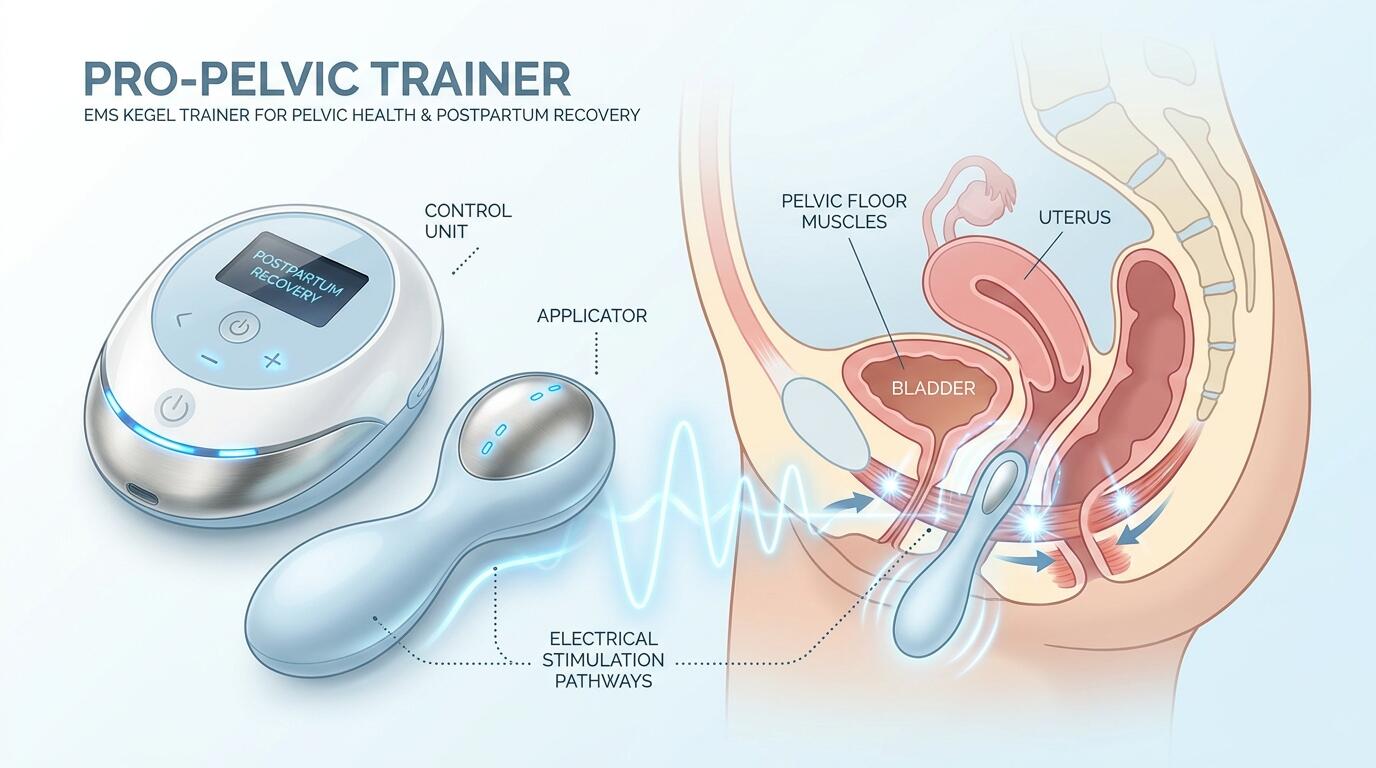
ALT: EMS Kegel trainer device illustrating pelvic floor muscle stimulation for postpartum recovery and women's pelvic health at home
Advanced Considerations: Getting the Most from Your Kegel Training Program
Addressing Common Misconceptions
Misconception 1: "More is always better with Kegel training."
This is one of the most widespread errors in pelvic floor training. Like any muscle group, the pelvic floor requires adequate recovery time between sessions. Overtraining can lead to muscle fatigue, increased tension, and paradoxically worsening symptoms — particularly for women who may already have elements of pelvic floor hypertonicity. Whether using EMS or manual techniques, following a structured protocol with rest days is essential.
Misconception 2: "EMS devices do all the work, so you don't need to engage mentally."
While EMS does produce muscle contractions without voluntary effort, research suggests that pairing EMS stimulation with conscious mental engagement — actively trying to contract along with the device — produces superior neuromuscular learning outcomes. Think of EMS as a guided teacher: it shows the muscle what to do, and your conscious participation cements the lesson.
Misconception 3: "Kegel exercises are only for postpartum women."
Pelvic floor training is relevant across the entire female lifespan — from young athletes to menopausal women to those preparing proactively for pregnancy. Preventive pelvic floor conditioning in women who have never experienced symptoms can reduce the likelihood of future dysfunction significantly.
Hypertonic Pelvic Floor: When Kegels Are Not the Answer
A hypertonic or overactive pelvic floor — characterized by muscles that are too tight rather than too weak — requires a fundamentally different approach. In this case, Kegel contractions (and some forms of EMS) can worsen pain, tightness, and dysfunction rather than relieving it. Symptoms may include pelvic pain, painful intercourse, or difficulty with bowel movements. If you suspect you may have a hypertonic pelvic floor, consult a qualified pelvic floor physiotherapist before beginning any training program.
Integrating EMS Training with Pelvic Floor Physiotherapy
For women working with a pelvic floor physiotherapist, an at-home EMS Kegel trainer can serve as a powerful adjunct — extending therapeutic stimulation between clinic appointments and accelerating progress. Many physiotherapists actively recommend quality home devices as part of a comprehensive rehabilitation plan. If you are under professional care, discuss incorporating an EMS trainer with your provider to ensure alignment with your individualized treatment protocol.
Frequently Asked Questions FAQ
Q1: How do I know if an EMS Kegel trainer is right for me?
An EMS Kegel trainer is most beneficial if you have difficulty feeling or isolating your pelvic floor muscles, have experienced postpartum muscle weakness, or have been struggling with urinary leakage despite attempting manual Kegel exercises without success. If you can already voluntarily engage your pelvic floor correctly and are simply looking to maintain tone, manual exercises may be sufficient — though EMS can still enhance results. When in doubt, consult a pelvic floor physiotherapist for an individualized assessment before choosing your training method.
Q2: Is EMS pelvic floor stimulation safe for long-term use?
EMS-based pelvic floor training has a well-established safety record when devices are used as directed by reputable manufacturers and appropriate contraindications are respected. Professional-grade devices from certified manufacturers, like iStim's ISO-certified lineup, are engineered for safe, effective home use. Long-term use is generally considered safe for healthy individuals; however, it is important to follow recommended session durations, avoid use during pregnancy without medical clearance, and discontinue use if unusual discomfort occurs. Always consult a healthcare provider if you have underlying medical conditions.
Q3: How long does it take to see results from Kegel training or an EMS device?
Most clinical research on pelvic floor training programs indicates that meaningful improvements in muscle strength and urinary control typically become noticeable within four to twelve weeks of consistent training — though individual timelines vary based on starting baseline, frequency of sessions, severity of dysfunction, and whether EMS or manual methods are used. EMS-assisted training may produce faster initial results for women with significant muscle weakness or poor voluntary control, while manual Kegels performed with correct technique can deliver sustained long-term conditioning once the foundational mind-muscle connection is established.
Summary
Pelvic floor health is a foundational pillar of women's overall wellbeing — and it deserves the same attention and investment as any other aspect of physical fitness. Whether you choose manual Kegel exercises, an EMS Kegel trainer, or a thoughtful combination of both, the evidence is clear: consistent, correctly executed pelvic floor training delivers measurable benefits across the lifespan.
Three core takeaways from this guide:
- EMS Kegel trainers bridge the gap between intention and execution — making pelvic floor training effective even for women who struggle with muscle awareness or correct technique.
- Manual Kegels build voluntary control that complements EMS stimulation, and the two methods work best when used together rather than viewed as competing options.
- Consistency and individualization are the ultimate determinants of success — the best Kegel trainer for women is the one she will actually use, correctly and regularly, in a format that fits her life and goals.
If you are ready to invest in your pelvic floor health, the next step is choosing a device that matches your needs — one engineered with clinical-grade quality, backed by trusted manufacturing, and designed for real women in real life.
Ready to Take the Next Step Toward Pelvic Floor Wellness?
Ready to take control of your pelvic health naturally and effectively? Explore iStim's full range of professional-grade EMS and Kegel devices at https://istim.com/ and find the right solution tailored to your wellness needs. Trusted by over 20,000 customers, iStim makes clinical-quality electrotherapy safe, simple, and accessible from the comfort of your home.
References
- National Institute of Diabetes and Digestive and Kidney Diseases (NIDDK). "Kegel Exercises."
https://www.niddk.nih.gov/health-information/urologic-diseases/kegel-exercises - Office on Women's Health, U.S. Department of Health and Human Services. "Pelvic Floor Disorders."
https://www.womenshealth.gov/a-z-topics/pelvic-floor-disorders - American College of Obstetricians and Gynecologists (ACOG). "Pelvic Support Problems."
https://www.acog.org/womens-health/faqs/pelvic-support-problems - National Institutes of Health (NIH), National Library of Medicine. "Electrical Stimulation for Urinary Incontinence in Women: A Systematic Review."
https://pubmed.ncbi.nlm.nih.gov/ - Mayo Clinic. "Kegel Exercises: A How-To Guide for Women."
https://www.mayoclinic.org/healthy-lifestyle/womens-health/in-depth/kegel-exercises/art-20045283
Note: Standards and clinical guidelines may be updated periodically. Please consult the latest official documents or a qualified healthcare professional for the most current guidance.
About iStim
iStim is a Los Angeles-based electrotherapy brand specializing in professional-grade TENS, EMS, and Kegel devices engineered for home use, backed by ISO-certified Taiwanese manufacturing and trusted by 20,000+ Amazon customers for drug-free pain relief and muscle stimulation. Learn more at istim.com.
© iStim. All rights reserved. This article is provided for informational and educational purposes only and does not constitute medical advice. Always consult a qualified healthcare professional before starting any new therapeutic regimen. Individual results may vary.